
We all have go-to words or phrases that we use on repeat at different stages of our lives. “Gnarly” is a funny word spoken explicitly by the character Jeff Spicoli in the classic movie Fast Times At Ridgemont High. Who could forget Sean Penn’s disheveled delivery? “Schwing” was a term coined by SNL characters Wayne and Garth in the sketch Wayne’s World to denote excitement or appeal. Remember the hilarious word “fetch” used persistently in the movie Mean Girls? Regina George famously belittled her frenemy Gretchen to, “Stop trying to make fetch happen.” PS, it didn’t. But for all of these words that did reach the mainstream, we knew the context so we were in on the joke. We knew how to decipher the code.
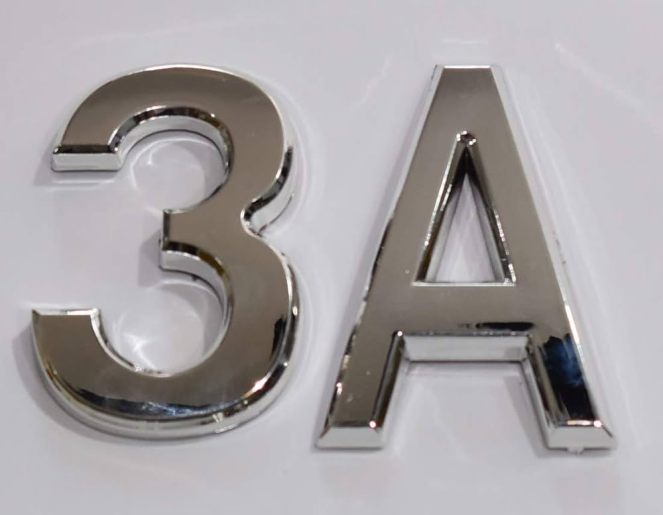
Most people that live on the island of Manhattan live in apartments. These apartments are usually designated with a floor number and a letter. Like I’ve lived in apartment 11G, 29C, etc. One building was forced to do away with the alphabet system because there were more than 26 apartments to a floor so they assigned just a number, which felt oddly unsatisfying. Maybe it’s just an NYC thing?
Anyway, before the internet or cellphones or Uber Eats, we would have to call restaurants from a landline to order takeout– like back in the stone age of 1994. And we used those paper menus the delivery peeps would annoyingly stick under our doors from which to select our choices. But the folks answering the phones at those loud, busy places couldn’t always hear us so clearly. So we would end up shouting, “Yes! The beef and broccoli! For apartment Twelve B? As in boy!” My boyfriend at the time would mess with the English as a second language order takers and say, “Yes, that’s apartment 17L as in Lladro.” They never got the joke. And we rarely got our food. Ugh.

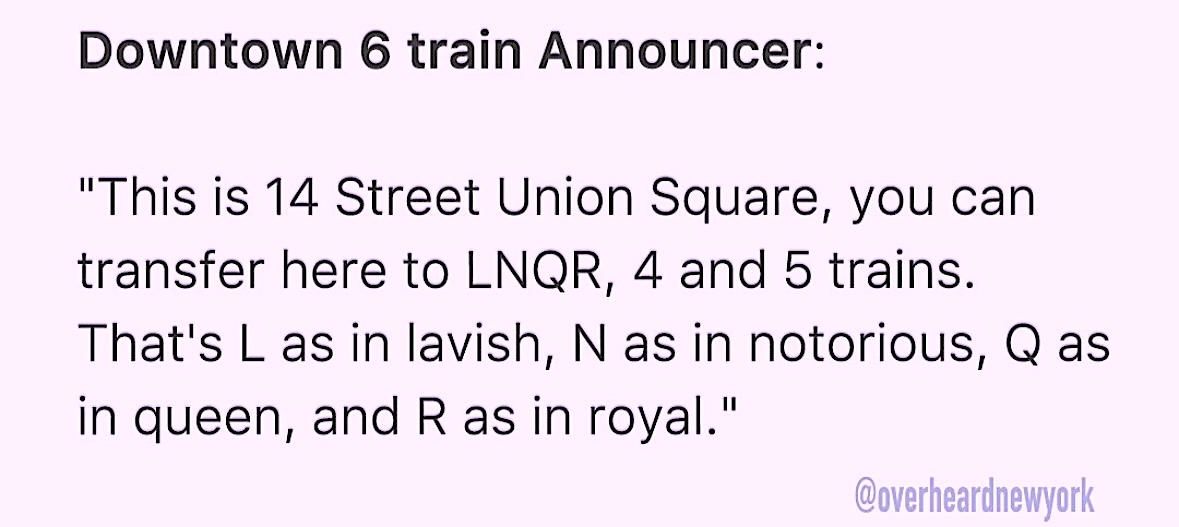
Even some subway conductors have gotten in on the action. Check out this funny announcer who had his own code words for letters to match words at Union Square in NYC…
Every time I have to spell my last name for a doctor’s office or client, it’s always the same thing. That’s R as in Robert, A, B as in boy, I, N as in Nancy, O, W, I, T as in Tom, Z. Ra-bin-o-witz. And then I pause to see if they correctly wrote down that whole mouthful because usually they stop writing after the first five letters assuming that I’m done. It’s exhausting. I bet you’re laughing right now as you think about how you say your last name to strangers making note of it.

I always knew there was a secret decoder on the alphabet to word crib sheet. I just never knew where it came from. So after a little research, here’s what I found. The NATO phonetic alphabet, including words like “Alpha” and “Bravo,” was developed in 1951 by the International Civil Aviation Organization. The notable linguist, Jean-Paul Vinay of the University of Montreal, created the initial alphabet list for ICAO. A spelling alphabet was used to distinguish those parts of a message that contained letters and digits, because the names of many letters sound similar. For instance bee and pee, en and em or ef and ess. The potential for confusion increases if static or other interference is present, as is commonly the case with radio and telephonic communication. For instance, the target message “proceed to map grid DH98” would be transmitted as proceed to map grid Delta-Hotel-Niner-Ait.
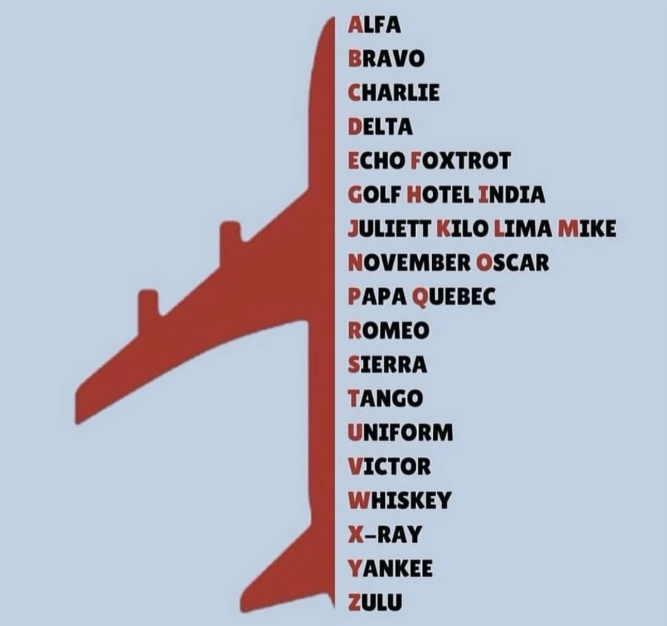
Of course this caught on with civilians too to avoid similar problems in the transmission of messages. So it’s no wonder that it trickled down to us when we ordered takeout! Or when companies need credit card authorization or to confirm a stock code. IT workers use it for long reference codes and airlines use it for passenger records.

We all use codes of sorts for confirmations, appointments, reminders and calendar invites. And now the world has so many safeguards against fraud that we face double authentication methods and added security measures to prove we are who we say with long multi-digit codes or pictures or magic questions to answers only we should know. I of course take this to the next level when I get takeout now by proclaiming with sincere spy protocol, “I have secured the package.” So of course Michael answers with, “Roger that.” And it cracks me up every time.


 jenslittleblackbook.com